


What Makes a Data Platform AI-Ready?
The short version
Why access alone is not enough
You can modernize your data platform for years and still give an AI agent a poor understanding of your business.
Most enterprises already have the foundation for AI-ready data. The warehouse is in place, pipelines are running, core models exist and governance may be mature.
Then AI agents arrive, and the assumption is that giving them access to the platform will make the data usable. It does not.
An AI-ready data platform is not a modern data platform with an LLM connected to it. It is a platform where agents need to infer less.
In this article
What you will learn
- why modern data platforms are not automatically AI-ready
- why agents need different modeling than BI users
- where semantic layers and ontology fit
- why context efficiency matters
- where data teams should focus first
The problem is not data access
The data exists, the meaning is scattered
In most mature enterprises, the data already exists. The problem is that its meaning is scattered across the estate.
Metric logic sits in BI tools. Entity definitions sit in warehouse models. Relationships are embedded in transformation code. Source-of-truth decisions live in documentation or in the heads of experienced employees. Humans compensate for this. Agents have to infer their way through it.
A human analyst knows which revenue model finance trusts. They know that “Account” in one system means “Customer” in another. They know which relationships matter and which joins are technically valid but commercially wrong.
Agents do not arrive with that institutional knowledge. They operate with finite context, retrieve selectively and have to decide what information matters before they can reason over it. If business meaning remains implicit, the agent has to reconstruct it at runtime. That is where reliability starts to break down.
What the agent still has to figure out
Take a simple commercial question:
Which customers have contracts renewing next quarter, what revenue is exposed and which products are affected?
The data may already exist across CRM, finance and contract systems. But the agent still needs to know:
- what counts as a customer
- what qualifies as a renewal
- how exposed revenue is calculated
- how contracts relate to products
- which source is authoritative
These are architecture problems, not model-intelligence problems. The more meaning an agent has to reconstruct, the less reliable the outcome becomes.
The objective is not more access. It is less ambiguity.
Humans fill in the blanks
Built for people, not agents
Most enterprise data models were designed for human consumption. A person looking at a dashboard brings context with them. They know how the business works. They can spot a strange number, ask a follow-up question or switch to another report.
An agent operates differently. It receives a task, a limited working context and access to a set of tools. Before it can reason, it has to decide what to retrieve. That makes implicit meaning expensive.
Here is what humans can compensate for, and what agents need instead:
- inconsistent terminology → explicit definitions
- tribal knowledge → authoritative sources
- implicit relationships → modeled relationships
- broad exploration → bounded retrieval
- follow-up questions → precise context
Data modeling for agents is not the same as data modeling for dashboards.
The existing models are not necessarily wrong. They were optimized for a different consumer.
Decide what agents should not infer
Make six things explicit
Start with the decisions you do not want the agent making. For most enterprise use cases, that means making a few things explicit:
- Business entities: What is a customer, contract, product or supplier?
- Metrics: What does revenue mean? Which definition is authoritative?
- Relationships: How do customers relate to contracts? How do contracts relate to products?
- Sources of truth: Which system should be trusted for a given concept?
- Rules: Which interpretations or relationships are valid?
- Access boundaries: What is this user or agent allowed to see and do?
Standardize analytical meaning with a semantic layer
This is where a semantic layer for AI becomes useful. A semantic layer standardizes analytical meaning. It tells the platform what the core entities are, how important metrics are calculated and which relationships are reusable across tools.
For our commercial example, that might mean: Customer → Contract → Product → Revenue. That already removes a large amount of runtime interpretation.
Formalize business structure only where needed
Analytical semantics have a limit. An agent may also need to understand that a reseller can be a customer, that a renewal is a type of commercial event, or that one legal entity can play several roles. Now the platform is describing the structure of the business itself. That is where ontology becomes useful.
The semantic layer standardizes analytical meaning. The ontology standardizes business concepts, relationships and rules. The goal is to make the context an agent receives more precise, not to load more of it into the agent.
Less context, better context
Why access to everything backfires
One of the easiest ways to make enterprise AI unreliable is to give an agent access to everything and expect the model to work out what matters. A warehouse with thousands of tables is not a good tool interface. An AI-ready platform should expose bounded capabilities instead.
Expose bounded capabilities
For one task, the agent may use semantic query. For another, search, graph traversal or a governed business function. The agent should decide which capability to use. It should not have to rediscover how the enterprise is structured every time it uses one.
The agent should not contain your enterprise knowledge. It should consume governed enterprise knowledge.
Optimize for context efficiency
Traditional data platforms are optimized around availability: can the user get to the data? Agent architecture introduces a harder question: can the platform provide the smallest useful context required to answer correctly?
An agent cannot reason over the entire enterprise data estate on every request, and it should not have to. Each part of the platform helps keep its context small:
- Better semantic structure reduces schema interpretation.
- Ontology reduces conceptual ambiguity.
- Search narrows unstructured evidence.
- Bounded tools reduce the surface the agent has to consider.
The result is more meaning per unit of context, which is a different design target from traditional BI.
An extension, not a rebuild
Do not build a second semantic estate
This is where many organizations overcomplicate the problem. The move toward agents is often treated as another reason to build a parallel platform. A separate vector store appears, then a separate knowledge platform, then another copy of business logic specifically for AI. Soon the organization has created a second semantic estate that needs to be reconciled with the first. For many enterprises, that is unnecessary.
A mature data platform may already contain:
- governed transformations
- documented entities
- metric definitions
- relationships
- lineage
- metadata
- access policies
Treat these as the raw material for the AI-facing layer, not as legacy artifacts.
Where humans still decide
Existing metadata, transformation logic and lineage already contain signals about business meaning. Much of the mechanical work required to expose that meaning can increasingly be generated or automated. Human effort should stay focused on the decisions automation cannot make reliably:
- Which definition is authoritative?
- Are two concepts genuinely equivalent?
- Which relationships matter?
- Which rules constrain interpretation?
- Where should domain boundaries sit?
The stronger the existing foundation, the smaller the AI extension may need to be.
The AI-ready data architecture
Five layers and one control plane
Once you decide that agents should infer less, the target architecture becomes fairly natural.
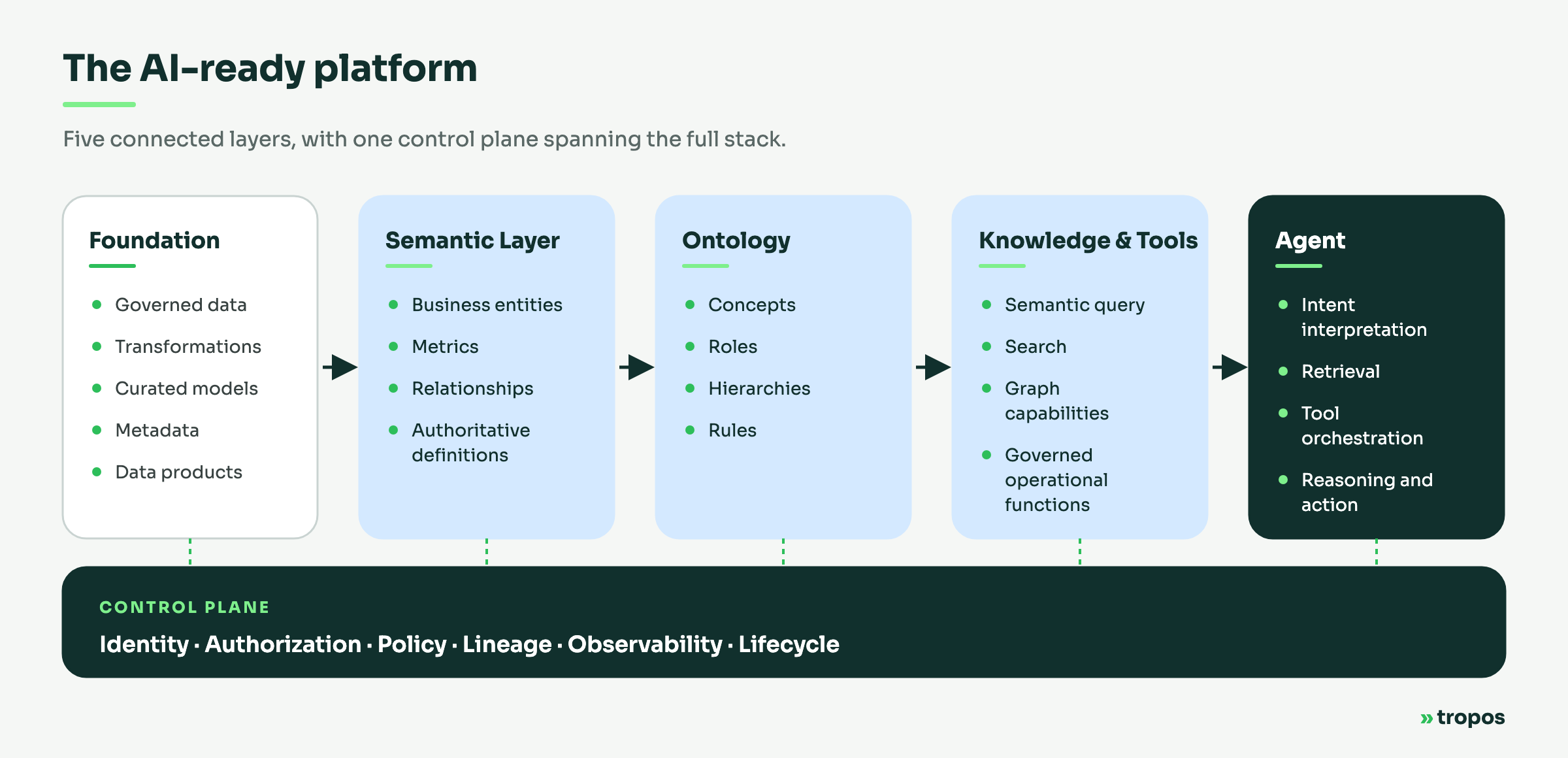
- Foundation: governed data, transformations, curated models, metadata and data products.
- Semantic Layer: business entities, metrics, relationships and authoritative definitions.
- Ontology: concepts, roles, hierarchies and rules where deeper reasoning requires them.
- Knowledge & Tools: semantic query, search, graph capabilities and governed operational functions.
- Agent: intent interpretation, retrieval, tool orchestration, reasoning and action.
A control plane spans the full stack: identity, authorization, policy, lineage, observability and lifecycle.
What matters is where responsibility lives, not how many layers there are. The platform remains responsible for governed knowledge. The agent remains responsible for using it.
The same principle applies to governance. Traditional data governance asks: can this user read this data? Agentic governance has to ask something more: can this agent use this tool, with this user’s authority, for this purpose? That distinction becomes critical as agents move from answering questions to taking action.
Where should data teams focus first?
Six steps, in order
Data readiness for AI follows a simpler sequence than the architecture diagram may suggest.
- Confirm the foundation. Make sure the core models, entities and authoritative sources are trusted.
- Formalize analytical meaning. Identify the metrics, entities and relationships that should never be inferred at runtime.
- Identify the ontology gap. Find the concepts, roles and rules that analytical semantics cannot express cleanly.
- Design bounded tools. Decide what the agent should query, search or invoke.
- Test context efficiency. Do not only test whether the agent can reach the answer. Test whether it can reach the answer with small, precise and governed context.
- Extend the control plane. Carry identity, access, policy, lineage and observability through the agent layer.
Is your platform AI-ready?
Six questions to ask your teams
Use these questions as a quick AI data readiness assessment. Ask your data and AI teams:
- Are our core business concepts consistent across systems?
- Can an agent identify which definition and source are authoritative?
- Are important relationships explicit?
- Which rules still exist only as institutional knowledge?
- Can the agent retrieve precise context rather than search the entire estate?
- Do user permissions survive agent-mediated access and actions?
If the answers are unclear, your platform may be modern. It is not yet reliably AI-ready.
FAQ
What is AI-ready data?
AI-ready data is data whose meaning, relationships, governance and access controls are explicit enough for an AI agent to use it without guessing. The data itself may be unchanged. What changes is how much interpretation the agent has to perform.
What is an AI-ready data platform?
An AI-ready data platform makes business meaning, relationships, governance and access controls explicit enough for AI agents to retrieve and use enterprise data reliably.
How do you make data AI-ready?
Start with one valuable agent use case. Confirm the trusted foundation, make its entities, metrics, relationships and rules explicit in a semantic layer, add ontology only where analytical semantics are not enough, and expose bounded tools instead of the whole warehouse. For a worked example, see How to Make Snowflake AI-Ready Without Rebuilding Your Data Platform.
Why is a modern data warehouse not automatically AI-ready?
A modern warehouse solves storage, transformation and access. Agents also need governed interpretation, precise context and bounded tools.
How is modeling for AI agents different from modeling for BI?
BI models are consumed by people who already carry substantial business context. Agents retrieve selectively within finite context, so important definitions and relationships need to be more explicit.
Do we need an ontology for enterprise AI?
Not always. Ontology becomes useful when agents need to reason across concepts, roles, domains or rules that conventional analytical models do not represent clearly.
Do we need to rebuild our data platform?
Usually not. Organizations with mature modeling and governance often already have most of the required foundation. AI readiness is commonly an extension of that foundation.
What should we do first?
Choose one valuable agent use case. Identify the smallest set of entities, metrics, relationships, rules and policies it needs. Make those explicit before expanding the scope.
AI readiness is not about giving agents more access. It is about reducing the amount of interpretation they have to perform.
Next in this series: How to Give AI Agents Consistent Business Meaning and How to Make Snowflake AI-Ready Without Rebuilding Your Data Platform.