


How to Make Snowflake AI-Ready Without Rebuilding Your Data Platform
The short version
Make the platform you run easier for agents to use
Most Snowflake teams already have the foundation for enterprise AI. The harder question is what to change next.
The fastest route is usually not to build a second AI platform beside Snowflake. It is to make the governed platform you already operate easier for agents to understand and use.
A Snowflake platform becomes AI-ready when agents can consume governed business context instead of rediscovering it from warehouse objects.
In this article
What you will learn
- how to turn existing Snowflake models into agent-ready context
- where Semantic Views fit
- when ontology adds value
- what can be generated from metadata and dbt
- how Cortex Search and Cortex Agents fit into the tool layer
- how to sequence the work without starting another platform transformation
One governed domain
Do not begin with enterprise AI
Begin with one valuable question or workflow and identify the Snowflake data products that already support it.
A useful starting domain has:
- curated business data
- stable transformation logic
- known authoritative sources
- clear ownership
- lineage
- access controls
If those foundations are weak, an agent layer will not fix them. It will make the weakness harder to see.
For a commercial use case, the trusted domain might already contain Customer, Contract, Product and Revenue models. The task is not to rebuild those models for AI. It is to expose their meaning in a form an agent can consume reliably.
Semantic Views
Make analytical meaning explicit
Snowflake Semantic Views are the core of a Snowflake semantic layer. They let teams represent business entities, metrics, dimensions and relationships as governed objects over existing Snowflake data. Snowflake Documentation
That matters because agents should not have to infer core analytical meaning from table names, joins or prompt instructions.
Instead of asking an agent which table represents a customer, define Customer.
Instead of asking it how revenue should be calculated, govern the metric once.
Instead of expecting it to discover a valid join path, make the relationship explicit.
Move important business interpretation out of prompts and implementation detail when it can be governed once in the platform.
Keep the semantic boundary narrow
Do not try to model the entire enterprise in one pass.
Build the smallest Semantic View that can support a defined class of questions. For example:
Customer → Contract → Product → Revenue
That boundary is enough if the agent needs to answer commercial questions about renewals, exposure and affected products. A supply-chain agent should get a different semantic boundary.
The objective is not maximum semantic coverage. It is enough governed context for one useful workload.
Where ontology fits
Add it only for concepts Semantic Views should not own
Semantic Views are strong at analytical interpretation. They should not become the enterprise's universal conceptual model.
Statements such as “Customer signs Contract” can fit naturally into an analytical semantic model. Statements such as “Renewal is a type of Commercial Event” or “a Legal Entity can be both Customer and Supplier” describe roles, classifications and rules that span domains.
That is where ontology becomes useful.
The practical question is not how to represent the whole enterprise in an ontology. It is:
Which concepts and relationships are agents currently forced to infer that should instead be explicit?
That usually produces a much smaller scope.
The ontology can remain a governed metadata layer mapped onto existing Snowflake objects. It does not require copying the warehouse into a separate graph platform. We cover this ownership model in How to Give AI Agents Consistent Business Meaning.
Generate the mechanical work
Reuse the signals already in the platform
A mature Snowflake environment already contains signals about business meaning:
- table and column metadata
- dbt models
- model relationships
- tests
- descriptions
- lineage
- query patterns
- semantic definitions
- access policies
These assets should reduce the manual work required to build the AI-facing layer. Snowflake also supports assisted Semantic View generation. Snowflake Documentation
Use automation to propose candidate entities, relationships, mappings and documentation.
Keep human judgment focused on the decisions that actually require business authority:
- Which definition is authoritative?
- Are two concepts genuinely equivalent?
- Which relationship matters to the business?
- Which rule should constrain interpretation?
- Where should the domain boundary sit?
The goal is not to automate semantics. It is to automate the mechanical work around semantic decisions.
A bounded tool surface
Expose tools, not the whole warehouse
Once the domain is explicit, decide which capabilities the agent should be allowed to use.
In Snowflake, that tool surface can include:
- Semantic Views for structured analytical questions
- Cortex Search for unstructured evidence
- governed functions or procedures for defined business operations
- graph-oriented projections or services where relationship traversal is central
Cortex Agents can orchestrate across semantic and search capabilities rather than treating the warehouse as one undifferentiated source. Snowflake Documentation
A good agent interface is smaller than your data platform.
That is the design principle. More available objects do not automatically produce better answers. A bounded capability with clear meaning is more useful than unrestricted access to hundreds of tables.
A commercial agent
How a renewal-risk question gets answered
Take a renewal-risk question:
Which customers have contracts renewing next quarter, what revenue is exposed and which products are affected?
A Snowflake-native execution path can look like this:
- Cortex Agent receives the question. It determines that the task needs structured commercial data and possibly supporting contract evidence.
- The agent queries a Semantic View. Customer, Contract, Product, Renewal and Revenue are already governed, so the agent does not have to reconstruct them from schemas or joins.
- Cortex Search retrieves supporting documents where needed. Contract clauses, renewal terms or related unstructured evidence can be retrieved without broad document search.
- Ontology metadata resolves cross-domain meaning where required. For example, it can distinguish a legal entity acting as Customer from the same entity acting in another role.
- The agent combines the results and returns the answer. The underlying Snowflake objects remain the governed sources.
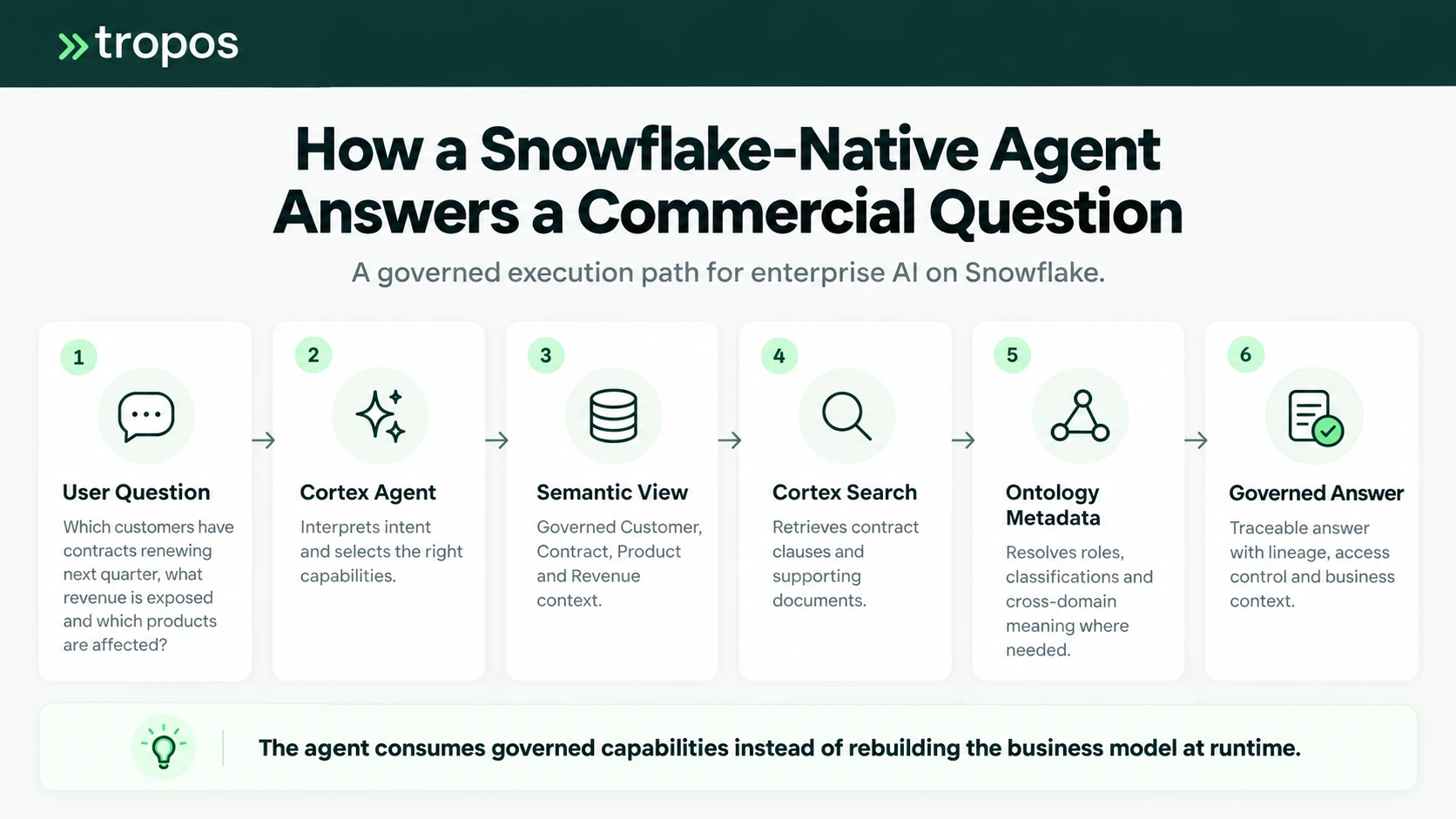
The important part is not the sequence itself. It is that the agent consumes governed capabilities instead of rebuilding the business model at runtime.
Governance
Keep identity and policy on the execution path
A governed Snowflake platform can still become poorly governed at the agent layer if identity and policy stop at the table boundary.
Agent-mediated access introduces additional questions:
- Can this agent use this tool?
- Can it use it on behalf of this user?
- Can it perform this action?
- Can the answer be traced back to its underlying sources?
Snowflake lineage can expose upstream dependencies through semantic objects and Cortex Search services, making agent execution paths easier to inspect. Snowflake Documentation
Identity, authorization, lineage and observability therefore need to travel through every capability the agent can invoke.
A Snowflake implementation sequence
Eight steps, in order
That means starting from trusted Snowflake data products, making analytical meaning explicit through Snowflake Semantic Views, adding ontology only where cross-domain concepts require it, exposing bounded tools to Cortex Agents and carrying governance through the execution path.
For most existing Snowflake customers, the work can be sequenced without launching another platform transformation.
- Select one governed domain. Choose the use case and the Snowflake data products that already support it.
- Create the Semantic View. Make the entities, metrics, dimensions and analytical relationships explicit.
- Generate candidate semantics. Reuse metadata, lineage, dbt models, tests and assisted tooling to reduce repetitive mapping.
- Add ontology metadata only where needed. Formalize cross-domain roles, classes, hierarchies and rules the semantic layer should not own.
- Design the tool surface. Decide when the agent should use Semantic Views, Cortex Search, governed functions or specialist services.
- Configure agent orchestration. Give Cortex Agents the smallest useful set of capabilities for the workload.
- Validate execution and governance. Check source selection, tool choice, context size, lineage and user authority.
- Expand the domain only after the first one works.
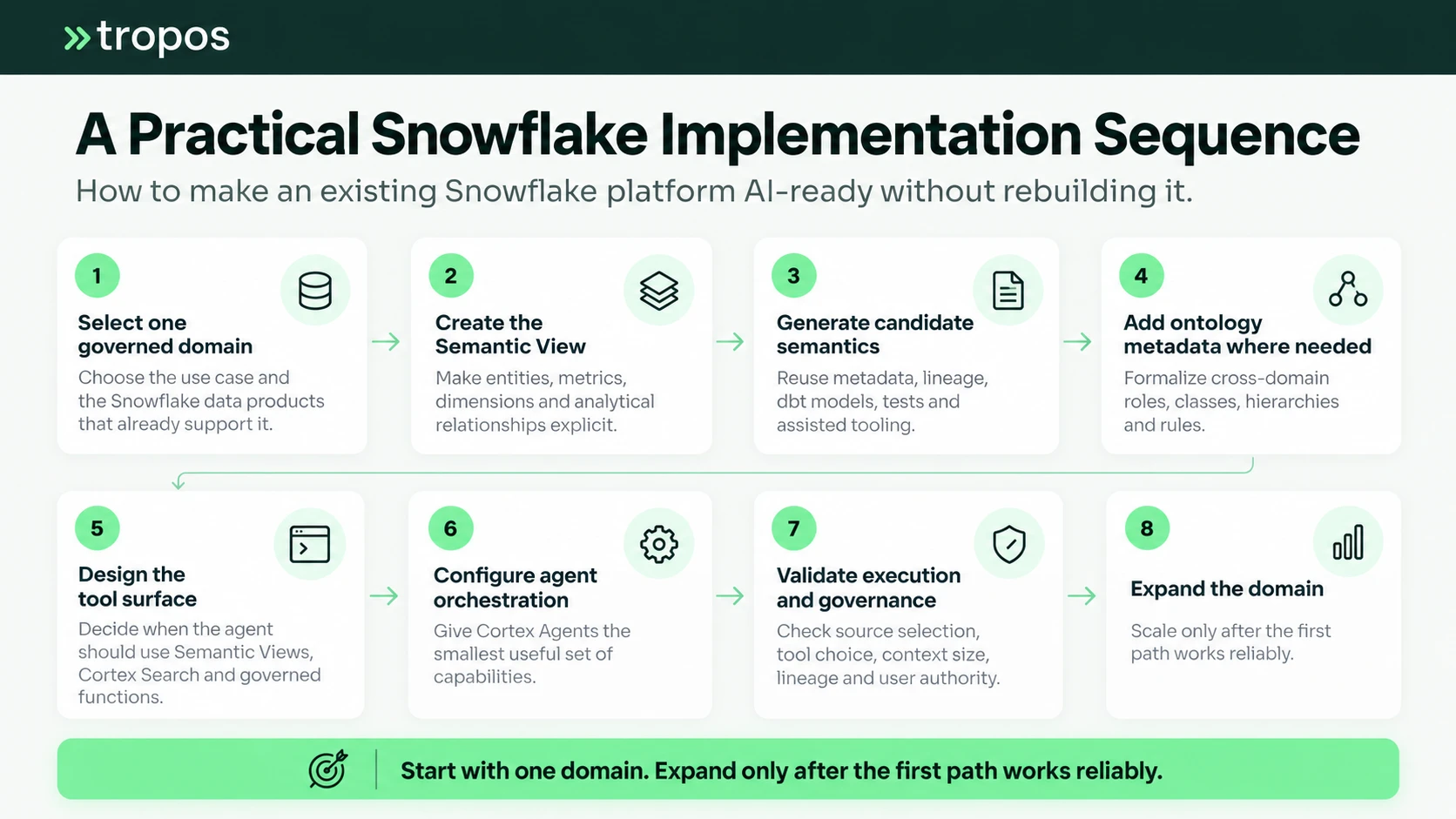
That sequence is deliberately narrower than a generic AI-readiness programme. It is an implementation path for teams that already run Snowflake.
The Snowflake target architecture
Five layers and one control plane

The architecture remains consistent with the broader AI-ready platform model:
- Foundation: Snowflake data, dbt and other transformations, curated models, metadata, lineage and governance.
- Semantic Layer: Semantic Views containing business entities, metrics, dimensions and analytical relationships.
- Ontology: Cross-domain concepts, roles, classifications, hierarchies and rules where required.
- Knowledge & Tools: Cortex Search, semantic query, graph-oriented capabilities and governed business functions.
- Agent: Cortex Agents or another governed orchestration layer handling intent, retrieval, tool selection and action.
Across all of them sits the control plane: identity, authorization, policy, lineage, observability and lifecycle.
What to do now
Six questions to start with
Start with six questions:
- Which Snowflake domain should the first agent use?
- Which models in that domain are already authoritative?
- Which entities and metrics belong in a Semantic View?
- Which remaining concepts require ontology-level structure?
- Which capabilities should Cortex Agents be allowed to invoke?
- Which parts of the semantic mapping can be generated from existing metadata?
If those answers are clear, the implementation path is usually much smaller than a new AI platform programme.
FAQ
What are Snowflake Semantic Views?
Snowflake Semantic Views are governed objects that represent business entities, metrics, dimensions and relationships over existing Snowflake data. They form the core of a Snowflake semantic layer, so agents do not have to infer analytical meaning from table names, joins or prompts.
What are Snowflake Cortex Agents?
Cortex Agents orchestrate across Snowflake capabilities such as Semantic Views and Cortex Search. They let an agent choose the right governed capability for a question instead of treating the warehouse as one undifferentiated source.
Does an existing Snowflake platform need to be redesigned for AI agents?
Usually not. If the underlying data is already well modeled and governed, the work is primarily to expose explicit semantics, bounded tools and agent-aware controls over that foundation.
Are Snowflake Semantic Views enough?
For many structured analytical use cases, they may be. Ontology becomes useful when agents need to reason across roles, classifications, rules or concepts that extend beyond conventional analytical semantics.
Does Snowflake need a native ontology product for this architecture to work?
No. Ontology is an architectural capability, not necessarily a single product object. It can be represented as governed metadata mapped onto existing Snowflake structures and tools.
Do we need a graph database?
Not by default. Graph-oriented representations become useful when deep or variable relationship traversal materially improves the workload.
Can existing dbt models be reused?
Yes. Existing models, tests, documentation, lineage and relationships can provide substantial input into Semantic View and ontology generation.
What should we implement first?
One governed Snowflake domain, one Semantic View and one bounded set of agent tools. Expand only after that path works reliably.
The fastest path to an AI-ready Snowflake platform is usually not another platform. It is making the governed Snowflake estate you already have explicit enough for agents to use.
Earlier in this series: What Makes a Data Platform AI-Ready? and How to Give AI Agents Consistent Business Meaning.